Autonomous survey boats · Northeastern University

We build boats that read the water.

D.R.E.A.M.S is a modular autonomous survey boat, designed and built from scratch by Northeastern engineering students to map water quality in small bodies of water.

V1 built in
1 semester
Radio link
≈ 1 km
Water test
London
Now
V3 in build
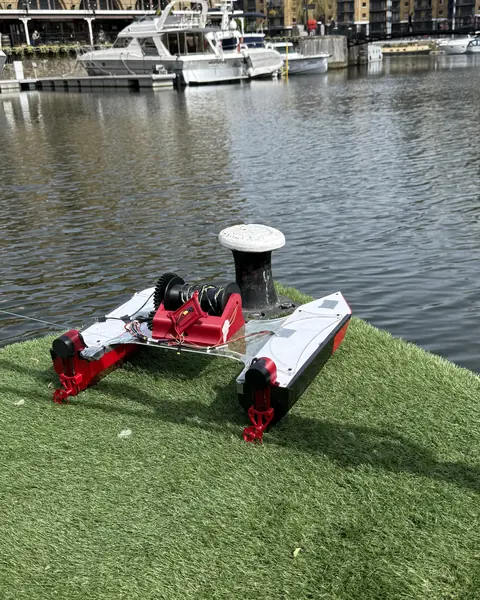
D.R.E.A.M.S V1 on the dock at St Katharine Docks, London, after its water test
BUILT IN ONE SEMESTER • TESTED IN LONDON •V1 St Katharine Docks · London

What D.R.E.A.M.S stands for

Data Recovery for Environmental And Marine Surveillance

01 · Why we build

Two students, one semester, a boat that drove itself on real water

We built the first D.R.E.A.M.S in London during our first year at Northeastern: a 3D-printed catamaran that navigated to GPS waypoints on its own at St Katharine Docks. Since then we've redesigned it twice. Now we're building a modular platform that labs, watershed groups and ports can send out to see what's in their water.

1semester to build and water-test V1
≈1 kmradio link to shore on V1
3generations, V1 → V3
5water-quality sensors on the V3 pod
02 · Build log

Built by hand. Tested in the water.

Every part was sketched, modeled, printed, wired and tested by us, including the parts that didn't work.

Open the full build log →
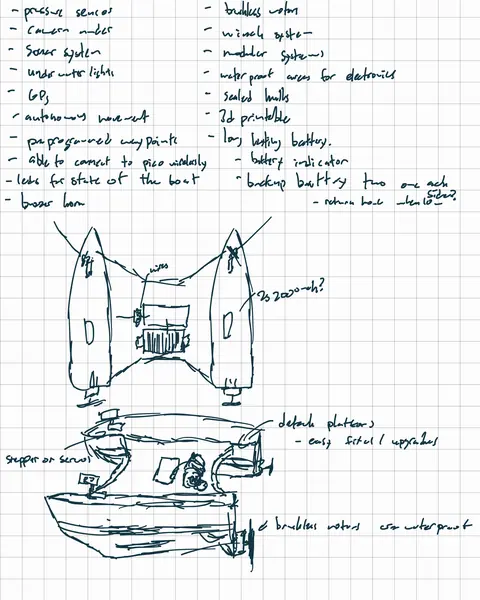
Hand-drawn concept sketch of the catamaran with a list of requirements
V1 · Spring 2026Designed

The first concept sketch

SolidWorks model of the catamaran bridge with the winch
V1 · SolidWorksDesigned

Bridge and winch in CAD

The 3D-printed V1 sensor pod
V1 · Sensor podBuilt

Printing the sensor pod

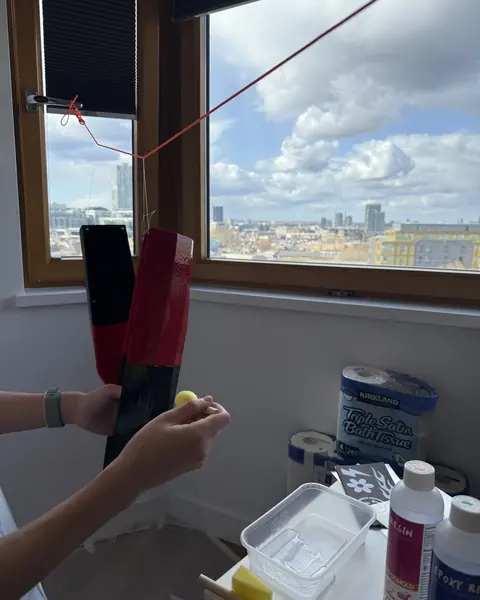
Brushing marine epoxy onto a printed hull
V1 · HullBuilt

Epoxy-sealing the printed hull

Our room in London set up as a workshop, with a hull section hanging over a taped-down drop sheet
V1 · LondonBuilt

A workshop in our room

Line drawing of an early jet-propulsion unit
V1 · PropulsionFailed

Jet drive

A dead end, but a useful one.

V1 · WinchTested

Weight-testing the winch

V1 at the edge of St Katharine Docks
V1 · LondonTested

Water test at St Katharine Docks

Fiberglass cloth wetted out with epoxy over a printed hull
V2 · Summer 2026Built

Fiberglass over a printed hull

Bringing up the first custom PCB on the bench
V2 · ElectronicsBuilt

First custom PCB, brought up

Stereo camera rig on the test bench
V2 · VisionTested

Stereo tracking on the bench

3D render of the V3 carrier board
V3 · Fall 2026Designed

Carrier board, rev F

Drag or scroll · 12 highlights
03 · The boat · V3 design

A platform, not a one-off.

V3 splits the boat into a Raspberry Pi 5 mission computer and two Raspberry Pi Pico 2 real-time controllers on one custom carrier board. Sensors and payloads are modular, so each build can be configured for the job.

Explore the boat →
Top view of the D.R.E.A.M.S V3 carrier board, rev F, with numbered callouts
  1. Two Raspberry Pi Pico 2sThe real-time controllers, socketed on the underside: one runs the motors, winch and RC, the other the sensors, GPS and the pod link. Only their header holes show here.
  2. Raspberry Pi 5 socketThe Pi plugs in here, face down on standoffs. The header carries its 5 V power, a serial link to the control Pico and a reset line for each Pico.
  3. CAN link to motor controllersTJA1051 transceiver and a 3-pin connector to the two VESC motor controllers, plus a jumper for the 120 Ω terminator.
  4. I²C sensor multiplexerTCA9548A splits one I²C bus into 8 channels: IMU, accelerometer, barometer, light sensor, two humidity sensors, power monitors, GPS compass.
  5. Sensor-pod link (RS-485)THVD2410 transceiver and a 4-pin connector for the tether to the water-sensing pod. The same cable carries 15 V to power the pod.
  6. GPS connector6-pin cable socket for the u-blox M10 GPS module: serial data plus the I²C lines of its built-in compass.
  7. RC receiver input (SBUS)3-pin socket for the radio-control receiver, the manual override. Its 5 V supply is fused loosely so it never nuisance-trips.
  8. Battery inputsTwo XT60 connectors take the boat's 10S battery bus: one feed for the electronics, and one for the winch used in the later sample-collection stage. A 5 V buck regulator on the underside powers the Pi and both Picos.
  9. Battery monitors (INA228)Two INA228 chips with shunt resistors measure voltage and current on the electronics and winch feeds.
  10. Winch safety cut-offA P-channel MOSFET switches power to the winch controller and fails safe: if the control Pico resets or loses power, the winch is off. Kept on the board for the later sample-collection stage.
  11. Backup battery inputAn optional small 4S battery plugs in on the underside. If the main packs go off, it keeps the Pi, both Picos and the radios running.
V3 carrier board · rev F · top view · tap a number
Platform
Modular twin-hull catamaranNew V3 hull in CAD
Mission computer
Raspberry Pi 5Navigation, missions, cloud link
Real-time control
2 × Raspberry Pi Pico 2Motors, sensors, safety
Drive
2 × VESC on CAN busDifferential steering, 10S Li-ion
Navigation
u-blox M10 GPSBNO085 IMU for heading
Depth
Fish-finder sonarReplaces the pod's pressure sensor
Sensor pod
ESP32-S3, RS-485 tetherpH · DO · TDS · turbidity · temp
Telemetry
4G LTELive map in the web dashboard
Carrier board
130.6 × 101.5 mm4 layers, rev F, fully routed
Pod board
48 × 63 mm2 layers, rev B
04 · Field test · St Katharine Docks

Tested on real water.

Our first boat was built in one semester in London. In its water test it navigated to GPS waypoints on its own and held a radio link of about 1 km to shore.

  • Built inOne semester, spring 2026
  • WhereSt Katharine Docks, London · 51.507° N, 0.072° W
  • AutonomyNavigated to GPS waypoints on its own
  • Radio433 MHz link, about 1 km to shore
  • SamplingPod lowered by winch; temperature, conductivity and light at the bottom
  • ElectronicsThree RP2040 boards: boat, shore station and pod
  • Shown atThe inaugural Creators' Showcase, Northeastern University London
Visitors gathered around D.R.E.A.M.S V1 at the Creators' Showcase
Creators' Showcase, NU London
05 · Roadmap

Where it's going.

Each version fixes what the last one taught us. The long-term goal goes beyond measuring water to collecting it.

Full roadmap →
  1. V1 · Spring 2026V1

    Proof of concept

    Autonomous waypoint navigation, a 1 km radio link and bottom sampling, on a 3D-printed hull.

    Complete
  2. V2 · Summer 2026V2

    The prototype that taught us

    A Pi 5 brain, stereo vision and our first PCB. Never fully built; bench tests exposed the flaws that drove V3.

    Prototype
  3. V3 · Fall 2026 · NowV3

    Autonomous surface surveys

    V3 will drive itself around small bodies of water, sample at the surface with the pod and measure depth with a fish-finder sonar.

    In build
  4. LaterNext

    Sample collection

    A robotic arm on deck that works with the winch to collect water samples and sediment from the bottom.

    CAD model of a cycloidal gearbox joint for the arm
    Arm in development
Why sediment

In our conversations with the Port of Oakland and the Charles River Watershed Association, we learned that their teams still collect sediment samples by sending divers down. An arm on an autonomous boat could do that job without anyone going in the water.

06 · Try it

Don't take our word for it.

V1's route planner and V2's command center both run right in your browser.

07 · Partners

Help us get V3 on the water.

We've built the boat ourselves so far. To finish V3 we're looking for funding, a mentor in the field, and places to machine and fabricate what we design.

Sponsor
PCBWayPCB fabrication
In conversation
Charles River Watershed Association (CRWA)Data collection
In conversation
Port of OaklandSediment sampling
  1. 01

    Funding

    Every dollar goes into hardware on the boat and getting V3 onto the water.

  2. 02

    A mentor in the field

    An engineer or scientist in marine robotics or water quality to review our designs and field plans.

  3. 03

    Machining & fabrication

    CNC machining for metal parts, and PCB assembly. PCBWay sponsors our board fabrication.

  4. 04

    Test sites

    Ponds and small lakes for field trials, with the survey data shared back.

08 · Team

Built by a team of four.

We design, build and test the hardware ourselves.

Meet the team →